BUSINESS · HUMAN RESOURCES
Morocco, Africa’s New Industrialization Leader: Is It Developing the Talent and Skills Its Industries Need?
 By S. Dahani · Founder & Publication Director
Morocco now tops the African Development Bank’s industrialization index. The harder test is training the engineers, managers and technicians its factories need.
© S. Dahani (AI illustration)
Quick Take
For years, South Africa was widely regarded as Africa’s industrial benchmark. Its manufacturing base, mining industry, infrastructure and large corporations gave it an advantage that appeared difficult to challenge.
But the industrial map of Africa is changing.
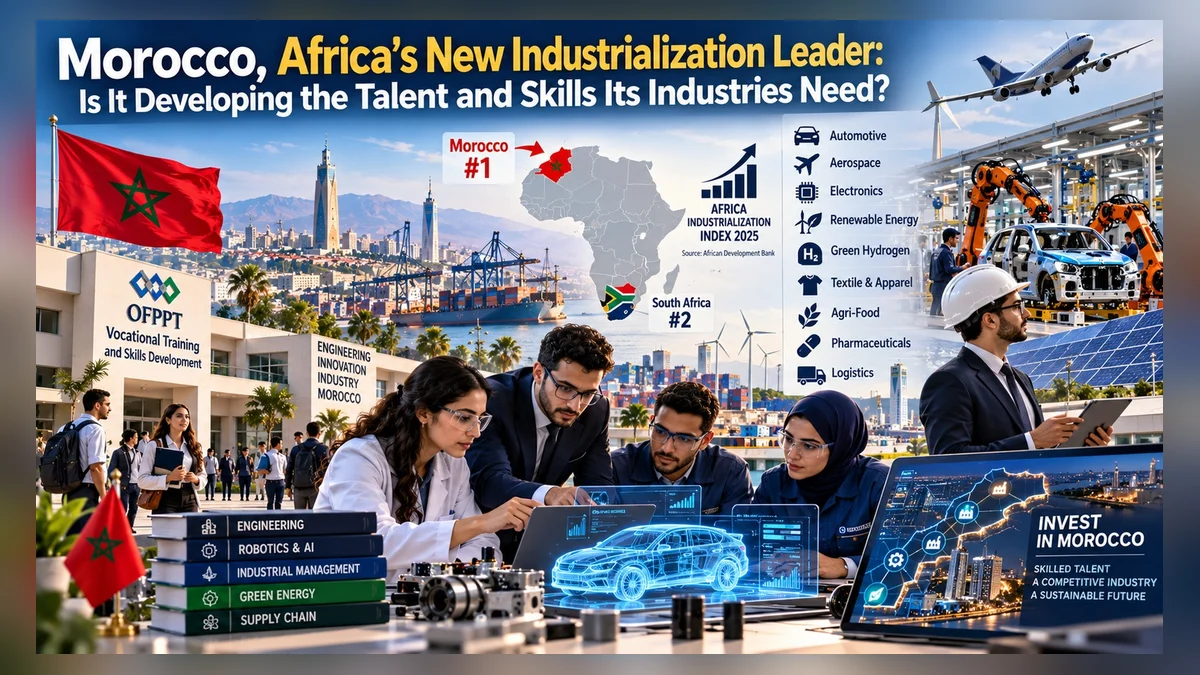
In the African Development Bank’s 2025 Africa Industrialization Index, Morocco moved into first place, overtaking South Africa, which had occupied the top position since 2010.
That achievement raises a question that may prove even more important than the ranking itself:
Can Morocco develop enough engineers, managers, technicians and highly skilled professionals to sustain the industrial economy it is building?
The answer matters because factories can be constructed relatively quickly. Developing human capital takes much longer.
Morocco overtakes South Africa — but what does “number one” actually mean?
The distinction requires some precision.
It would be inaccurate to claim that Morocco has overtaken South Africa according to every possible measure of industrial power.
What the African Development Bank established is more specific — and nevertheless significant.
Its 2025 Africa Industrialization Index evaluates industrial development across 54 African countries over the 2010–2024 period.
Morocco reached the top position with a score of 0.8415, overtaking South Africa for the first time in the index.
According to the Bank, Morocco’s rise reflects sustained industrial upgrading, export diversification and an active industrial policy, while South Africa has experienced a gradual deterioration in several indicators.
This is not simply a symbolic change in a league table. It reflects a longer transformation of the Moroccan economy.
From low-cost production to industrial ecosystems
Morocco’s industrial strategy has gradually moved beyond attracting isolated foreign factories.
The country has attempted to create entire ecosystems around major industries.
Automotive manufacturing is perhaps the clearest example.
Renault’s Moroccan operations demonstrate the scale that has been reached. According to Renault Group, Morocco was its second-largest industrial platform worldwide by production volume in 2025, producing approximately 394,000 vehicles.
The group also reports that 82% of the output of its Tangier and Casablanca operations is exported to 63 destinations.
The implications extend well beyond Renault itself.
An automobile plant requires component suppliers, logistics specialists, maintenance engineers, quality-control professionals, automation experts, software systems, purchasing managers and thousands of trained workers.
An industrial ecosystem therefore creates its own educational requirements.
Automotive is only part of the story
Morocco’s industrial ambitions now extend across several sectors.
Automotive manufacturing has been joined by aerospace, electronics, renewable energy, logistics and other advanced activities.
This diversification changes the skills equation.
A country competing mainly through labor costs needs workers.
A country competing through sophisticated manufacturing needs something more difficult to produce:
engineers, middle managers, specialized technicians, project leaders and professionals capable of operating increasingly automated industrial systems.
And this is where Morocco’s industrial success faces one of its most important tests.
Can education keep pace with factories?
Morocco appears to have understood the problem.
Its response has increasingly involved bringing vocational education closer to the needs of industry.
The Office for Vocational Training and Employment Promotion — OFPPT — announced a total capacity of more than 418,000 training places for the 2025–2026 academic year.
Its network included 510 operational institutions, while new Cities of Trades and Skills were being progressively opened across the country.
This model is significant because it attempts to move away from a purely academic definition of education.
The objective is increasingly to ask:
What skills does the economy actually need, in which region, and for which industry?
A school built around the factory
Perhaps the most revealing example comes from the automotive industry.
Morocco created specialized Institutes for Training in Automotive Industry Professions, known as IFMIA.
The Ministry of Industry describes human-resource training as a strategic component of Morocco’s industrial policy and explicitly links the availability and quality of skills to the country’s attractiveness, productivity and competitiveness.
The system includes specialized training facilities serving major automotive centers such as Casablanca, Kenitra and Tangier.
This creates an interesting model.
Instead of universities and training centers producing graduates independently and hoping that companies will recruit them later, training can increasingly be designed around identifiable industrial requirements.
In other words:
the factory helps define the school.
Renault offers a concrete test case
The Renault experience shows how far this relationship can go.
Renault Group says the IFMIA institute it has managed in Tangier since 2011 has delivered approximately 3.2 million hours of industrial-skills training, including automation, robotics and electrification.
The institute does not exclusively serve Renault.
Part of its activity supports suppliers, industrial partners and youth employability programs within the wider automotive ecosystem.
This is important because an industrial hub cannot depend indefinitely on importing expertise.
Foreign investment creates substantially more long-term value when knowledge and technical competence become embedded locally.
The strategic question is therefore not simply:
“How many foreign companies has Morocco attracted?”
It is:
“How much expertise remains in Morocco after those companies arrive?”
The emergence of an industry–education partnership
This may represent one of the most interesting aspects of the Moroccan model.
Traditional education systems generally operate according to a relatively slow cycle: programs are designed, students study for several years and graduates subsequently enter a labor market that may already have changed.
Industry 4.0 operates at another speed.
Robotics, artificial intelligence, digital twins, advanced electronics, battery technologies, data analysis and automated logistics can transform professional requirements within a few years.
Consequently, Morocco cannot simply train more people.
It must continuously update what they are trained to do.
Recent recruitment in Morocco's industrial sector illustrates this demand. Positions advertised by manufacturers such as Stellantis in Kenitra include responsibilities involving industrial systems, team coaching, internal training, performance monitoring and continuous improvement.
The modern industrial manager is therefore no longer merely supervising production.
He or she increasingly operates at the intersection of technology, people, data and continuous learning.
Morocco’s real challenge: moving up the skills ladder
The first stage of industrialization is attracting production.
The second is developing local suppliers.
The third — and more difficult — is increasing the proportion of knowledge, engineering, design, management and innovation created domestically.
That progression determines whether a country remains primarily a manufacturing location or develops into a genuine industrial and technological center.
Morocco has already demonstrated that it can attract major international manufacturers.
Its next challenge is to increase the number of Moroccan professionals capable not only of operating industrial systems, but also of designing, managing and improving them.
This means strengthening several categories of expertise:
- Engineering and industrial management
- Automation, robotics and artificial intelligence
- Electronics and embedded systems
- Energy and environmental engineering
- Supply-chain and logistics management
- Quality management
- Research and development
- Data and industrial cybersecurity
- Leadership capable of managing multicultural and technologically sophisticated organizations
The question of senior talent
Vocational training is essential, but it represents only one part of the equation.
If Morocco wants to move further up global value chains, it also needs senior professionals capable of assuming positions traditionally concentrated at multinational headquarters: engineering directors, R&D managers, supply-chain strategists, industrial-data specialists, senior project managers and technology leaders.
That requires closer cooperation between universities, engineering schools, vocational institutes and companies.
It also means that success should not be measured exclusively by the number of graduates.
A more meaningful measure is whether graduates possess the competencies that companies actually require.
Foreign companies can become schools
There is another dimension that deserves attention.
A multinational company entering Morocco does not bring only capital and machinery.
It can also bring manufacturing standards, management systems, engineering methods, quality procedures and international supply-chain expertise.
When Moroccan engineers and managers acquire those methods and subsequently transmit them to other companies, create businesses or train younger professionals, foreign investment produces a second form of capital:
knowledge capital.
This may ultimately prove more valuable than the factory itself.
Renault’s involvement with IFMIA illustrates how an industrial investor can participate directly in developing the surrounding skills ecosystem.
The challenge is to reproduce and deepen this model across other strategic sectors.
A success story — but not a finished one
Morocco’s new position at the top of the African Development Bank’s industrialization index is significant.
But it should be interpreted as a milestone rather than a finish line.
Africa itself still represents less than 2% of global manufacturing output and only about 1.4% of global manufactured exports, according to the African Development Bank.
Morocco is therefore not merely competing with South Africa, Egypt or other African economies.
Its industries compete for investment, technology and talent with manufacturing platforms in Eastern Europe, Asia, Latin America and the Mediterranean.
The benchmark must consequently become global.
The factory of the future requires the school of the future
Morocco has spent years building ports, highways, industrial zones, automotive plants, aerospace clusters and renewable-energy infrastructure.
The next infrastructure may be less visible.
It is human capital.
The country’s emerging training ecosystem — from OFPPT and the Cities of Trades and Skills to specialized industry institutes such as IFMIA — suggests that Morocco is attempting to connect education more directly with economic transformation.
But industrial leadership will ultimately depend on whether this system can evolve as rapidly as technology itself.
The decisive question is no longer simply whether Morocco can attract the factories of tomorrow.
It is whether it can produce the engineers, managers, researchers and technical leaders capable of running, improving and eventually designing them.
If it succeeds, Morocco’s rise in Africa’s industrial rankings may represent something larger than an economic achievement.
It could mark the transition from a country that attracts global industry to one that increasingly creates the skills, knowledge and leadership on which global industry depends.
Sources
- African Development Bank Group — Africa Industrialization Index 2025, published May 2026 (Morocco ranked first among 54 African economies, ahead of South Africa)
- African Development Bank Group — Morocco named Africa’s industrialization leader in new African Development Bank Index, May 25, 2026
- Morocco Ministry of Industry and Trade — Automotive industry and training (IFMIA institutes)
- OFPPT — 2025–2026 vocational training program (training network, capacity and Cities of Trades and Skills)
- Renault Group — Tangier Factory - The Industrial and Logistics Hub Where Everything Comes Together, 2026
- OFPPT — TADAROJ 2026–2027 work-study training
- Stellantis Careers — Industrial System Pilot, Kenitra, 2026 (example of current industrial competency requirements)