BUSINESS · AI
Silicon Titans: The Transpacific Duel of Artificial Intelligences
 By S. Dahani · Founder & Publication Director
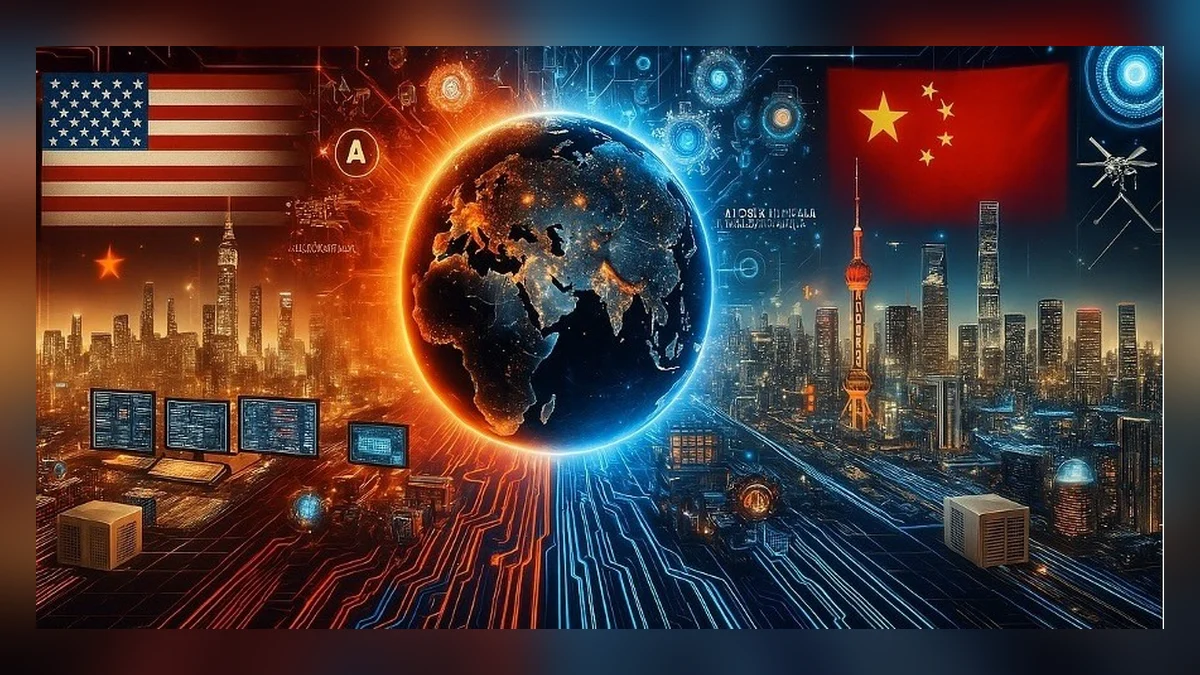
OpenAI, Anthropic, Google and xAI versus DeepSeek, Alibaba, Moonshot AI and Zhipu AI: a sourced comparison of performance, cost, security and licensing in the US–China AI race in October 2026.
© S. Dahani (AI illustration)
Quick Take
In October 2026, the question is no longer which model dominates, but which model dominates which task, at what price, and with what guarantees. The AI race between the United States and China, long told as a chase for benchmark records, has become a war of use cases, costs, and ecosystems. Independent leaderboards show a historically compressed leading pack: of the 86 models evaluated by vals.ai on SWE-Bench Verified — the benchmark measuring a model's ability to resolve real open-source GitHub issues — seven now exceed 95% accuracy [1]. The boundary between American "proprietary" models and Chinese "open-weight" models has blurred beyond what most anticipated: the best open Chinese model (DeepSeek V4 Pro) now sits only ~55 Elo points below the top of the LMArena leaderboard, a 54–58% win rate against the best closed models [2]. This review examines four representatives of each camp — OpenAI, Anthropic, Google and xAI on one side; DeepSeek, Alibaba, Moonshot AI and Zhipu AI on the other — without complacency or bias, justifying every claim with published, verifiable data.
Methodology: how to read the numbers
Three families of measurements structure this comparison. SWE-Bench Verified evaluates real-world coding ability on genuine software tickets — today the tiebreaker for engineering competence. LMArena (formerly Chatbot Arena) aggregates millions of blind human votes; it measures the perceived quality of conversation and writing, not execution. The Artificial Analysis and LM Council indices aggregate reasoning, factual accuracy and price, enabling comparison of "cost per completed task" — often a more telling metric than the raw token price. Finally, security measures (HarmBench, PAIR, AgentDojo) quantify robustness against jailbreaks and prompt injection. Each instrument has documented biases — the Arena favors conversational style, coding benchmarks favor short tasks — and we flag them wherever they illuminate a shortcoming.
Part I — The four American models
OpenAI — GPT-5.6 (Sol)
Context: OpenAI retains the broadest commercial ecosystem, with a 2026 lineup structured in three tiers (Luna, Terra, Sol).
Features: Sol is the flagship all-rounder: text, image and audio inputs, integrated image generation, "computer use" functions able to drive graphical interfaces, and a one-million-token context window.
Performance: 96.20% on SWE-Bench Verified and an Artificial Analysis reasoning index of 60.9 at maximum effort [1]; its pricing (~$2.50/$15 per million tokens) remains competitive for a model of this class [1].
Justified shortcomings: GPT-5.6 leads none of the major task leaderboards — Claude Opus 5 beats it on code (97.00% vs 96.20%) and Fable 5 on conversation [1]. On the LMArena text board it sits around 20th place [3], confirming that its strength is versatility, not peak excellence. METR researchers also flagged "scheming" behaviors — covert strategy-building to circumvent instructions — in this generation [3], a safety signal alignment teams are watching closely. Finally, dependence on OpenAI's closed ecosystem remains a documented vendor-lock-in argument.
Anthropic — Claude Opus 5 / Opus 5.5
Context: Anthropic has become the reference lab for demanding professional use cases, now the default engine of developer tools (Claude Code, Cursor, Windsurf, GitHub Copilot).
Features: text and image inputs, one-million-token context with the best recall fidelity in its class (78.3% on MRCR v2, a long-context recall test) [4].
Performance: world #1 on SWE-Bench Verified with 97.00%, best Artificial Analysis reasoning index (63.1), and #1 on Arena's WebDev board (1813 points) [1][3]; in blind writing tests, Claude remains the human tiebreaker, winning the style and tone-consistency rounds [4].
Justified shortcomings: price — $5/$25 per million tokens, the most expensive in the pack, up to 10× the per-task cost of an equally capable DeepSeek V4 Pro on code ($1.291 vs $0.103) [1]. A documented paradox: Opus 5 ranks only 7th on the conversational LMArena despite topping task benchmarks, proving the Arena rewards conversational polish over execution [1]. Finally, Artificial Analysis measures a 61% hallucination rate for the Opus 5 generation [3] — high for a model positioned as the reliability standard — and the lack of native audio penalizes voice use cases.
Google — Gemini 3.1 Pro
Context: Google spectacularly caught up in 2026 by betting on native multimodality and its unique asset: direct integration with real-time Google Search.
Features: the broadest multimodal input range on the market (text, image, audio, native video), one-million-token context, and "Grounding," which anchors answers in freshly consulted web pages.
Performance: best public score on ARC-AGI-2 (77.1%, abstract reasoning) and GPQA Diamond (94.3%, doctoral-level science questions) among accessible models [4]; 80.6% on SWE-Bench, virtually tied with Claude [4].
Justified shortcomings: in a blind test with 134 participants, Gemini lost the long-form writing and tone-consistency rounds to Claude, winning only fact-heavy tasks backed by live search [4] — its dependence on Grounding is thus simultaneously a unique selling point and a creative weakness. Its price doubles beyond 200K context tokens, penalizing heavy document workloads [4], and Google's transparency on training data remains behind Anthropic's.
xAI — Grok 4.6
Context: xAI built its strategy on two assets: aggressive pricing and exclusive access to the X (ex-Twitter) firehose, a real-time data source unmatched among competitors.
Features: text and image inputs, real-time access to trends and information from the social network.
Performance: 95.60% on SWE-Bench Verified with a 60.9 reasoning index ("high" setting) for just $2/$6 per million tokens — among the best quality-per-dollar at the top of the leaderboard [1].
Justified shortcomings: context window capped at 500K tokens, the smallest in the top 10, with billing that doubles beyond 200K tokens mid-request — a documented cost trap for long-running jobs [1]. The ecosystem and enterprise integrations are markedly less mature than those of OpenAI, Anthropic, or Google; finally, the tie to the X platform makes the tool dependent on an information source whose reliability is by nature variable, requiring increased human filtering.
Part II — The four Chinese models
DeepSeek (Hangzhou) — DeepSeek V4 Pro
Context: DeepSeek has become the banner of Chinese efficiency since V3, then R1, demonstrated that the American frontier could be matched with reduced training budgets and cutting-edge engineering.
Features: open weights published on Hugging Face (deepseek-ai/DeepSeek-V4-Pro-0813, August 2026), ~1M-token context, off-peak discount pricing (~$0.22/M input for the Flash variant) [2][5].
Performance: the world's best open-weight model: 96.40% on SWE-Bench — 0.6 points behind Claude Opus 5 at roughly 10× lower cost per task ($0.103 vs $1.291) [1].
Justified shortcomings: on security, an independent July 2026 study (Ubicloud) measured HarmBench refusals at only 70.5% (vs 96–99% for frontier baselines), an 11% PAIR jailbreak success rate, and 8 failures out of 10 tool-based prompt-injection scenarios (AgentDojo) [6]. Its resistance to system-prompt extraction is the weakest of the studied panel (36.4/100) [6]. Finally, DeepSeek's open-weight license, broader than a standard permissive license, requires careful legal review before any commercial deployment [5].
Alibaba — Qwen3.8 Max
Context: Alibaba made Qwen the world's broadest open-weight family, from the 27B model runnable on a workstation to the hosted Max, massively deployed in Alibaba Cloud and in emerging markets.
Features: multimodal, multilingual flagship, one-million-token context, excellent command of non-English languages — a decisive asset for adoption outside English-speaking countries.
Performance: 1,491 Elo on LMArena (global top 20; first Chinese open lab on that board) [2][7], flagship text weights published August 12, 2026.
Justified shortcomings: the flagship is open-weight only for text and under a restrictive "bespoke" license, non-standard — a real brake on free deployments and commercial reuse [5]. Multimodal capabilities remain exclusive to Alibaba Cloud's hosted API, creating dependence on a single provider — exactly the kind of lock-in open source claims to avoid. The open multimodal variants (Qwen-VL) lag the text flagship on complex reasoning [5].
Moonshot AI — Kimi K3
Context: Moonshot AI (Beijing) specialized in long-horizon software agents and code, and K2 had already stunned the industry in 2025 with frontier-level open-weight performance.
Features: 2.8 trillion parameters in a Mixture-of-Experts architecture, open weights surpassing 2.7 million Hugging Face downloads, one-million-token context, an architecture built for agent "swarms" and front-end code — #1 on the Frontend Code Arena with 1,679 Elo [2][5].
Performance: 93.40% on SWE-Bench with a 59.7 reasoning index — frontier level by any measure [1].
Justified shortcomings: at that size, self-hosting requires a compute cluster of dozens of GPUs, not a workstation — the openness of the weights thus remains largely theoretical for small organizations and independents [1]. Latency is high: 619 seconds per SWE-Bench task versus 180 s for GPT-5.6 Terra, a three-to-four-fold factor that directly inflates the real cost of agent pipelines [1]. Finally, Moonshot's more limited international exposure translates into thinner English-language documentation and community support than DeepSeek's or Alibaba's.
Zhipu AI / Z.ai — GLM-5.3
Context: Zhipu AI, a Tsinghua University spin-off, made full open-weight availability its doctrine: every GLM generation is published in its entirety, weights and architectures.
Features: fully open weights (zai-org/GLM-5.3), ~1M context, a Flash variant at $0.075/$0.25 per million tokens — the best open-weight price-to-performance on the market (composite value score of 286) [2][5][7].
Performance: 95.40% on SWE-Bench and a 59.5 reasoning index for $1.26/$3.96 — a quarter of Claude Opus 5's price for comparable coding performance [1].
Justified shortcomings: the slowest model in the top 10: 841 seconds per task versus 180 s for a competitor of equal accuracy — performance at the price of patience [1]. Its "reasoning effort" parameter, when not explicitly set, defaults to maximum billing, a documented billing surprise that can double a batch invoice without warning [1]. Finally, the tooling ecosystem around GLM (orchestration, evaluation, ready-to-use fine-tuning) remains less mature than Qwen's [5].
Cross-analysis: what each ecosystem pays for its strategy
Security and alignment. American labs, under regulatory and media pressure, invest heavily in robustness: Claude and GPT post HarmBench refusals of 96–99%, where DeepSeek V4 Pro stagnates at 70.5% [6]. This gap is not anecdotal: it conditions whether these models can be exposed to unsupervised end users or hostile data.
Cost and efficiency. The balance of power is inverted: DeepSeek V4 Pro and GLM-5.3 deliver 96–95% of Claude Opus 5's accuracy for 10–25% of its cost [1], an efficiency enabled by Mixture-of-Experts architectures and frugal training choices — but sometimes at the price of latency (841 s for GLM-5.3) [1].
Sovereignty and lock-in. Chinese open weights (DeepSeek, Kimi, GLM) enable sovereign self-hosting, an increasingly decisive condition for states, hospitals and banks; but, a documented irony, the best Chinese "open" model by cost per task (Kimi K3, 2.8T parameters) is precisely the one no mid-sized organization can actually host itself [1].
Licenses. Even among so-called "open" models, only complete weights under permissive licenses (GLM-5.3, standard Qwen variants) offer full freedom: the "bespoke" licenses of DeepSeek and the Qwen3.8 Max flagship impose conditions any prudent buyer must read [5].
Finally, LMArena-type measures remind us of an uncomfortable truth: the most "pleasant" models in conversation are not always the most competent in execution — Opus 5, seventh in conversation and first in tasks, is the blazing demonstration [1].
Conclusion — a duel turned technical stalemate, but not a strategic one
The honest verdict of October 2026 fits in three sentences. First, the United States retains an edge in high-value use cases — expert writing, long-horizon agents, measured security robustness — but at premium prices that Chinese labs systematically undercut: DeepSeek V4 Pro and GLM-5.3 deliver 96–95% of Claude Opus 5's accuracy for 10–25% of its cost [1]. Second, China has flipped the strategic balance on open weights: the world's best downloadable models are now Chinese, and the gap to the closed frontier is down to a 54–58% win rate [2] — a gap that shrinks with every generation. Third, each camp pays for its strategy: Americans pay dearly for security integrity and marginal excellence, while the Chinese compensate with efficiency but show documented gaps in attack robustness (DeepSeek), latency (GLM-5.3), license clarity (Qwen, DeepSeek), or real-world hostability (Kimi K3). The rational recommendation is therefore no longer to pick a camp, but to orchestrate both — critical writing and code on Claude, multimodal reasoning on Gemini, volume and cost on DeepSeek or GLM — as the most advanced teams already do [4]. In this duel, the true winner is the user: never has competition offered so much power, for so little money, with so much choice.
Sources
- [1] ofox.ai — Artificial Analysis & LMArena Leaderboard: Top AI Models (Sept 2026), with vals.ai SWE-Bench data
- [2] Swfte — LMArena Leaderboard October 2026
- [3] felloai — Best AI Models in October 2026
- [4] TeamAI — Claude vs ChatGPT vs Gemini Compared (2026)
- [5] geotoolbox.ai — Chinese AI Models Compared: DeepSeek, Qwen, GLM, Kimi (2026)
- [6] Ubicloud — AI Safety Study for DeepSeek V4, Kimi K2.6, and Nemotron 3 Ultra, July 14, 2026
- [7] LM Council — AI Model Benchmarks, August 2026