
BUSINESS · ECONOMY
From the Pandemic to the Strait of Hormuz: A World Moving from Crisis to Crisis — Who Really Pays the Price of Economic Disruption?
 By S. Dahani · Founder & Publication Director
COVID-19, the war in Ukraine and disruptions in the Strait of Hormuz have piled up debt, inflation and lost investment. Who ultimately pays for a global economy that no longer has time to recover between shocks?
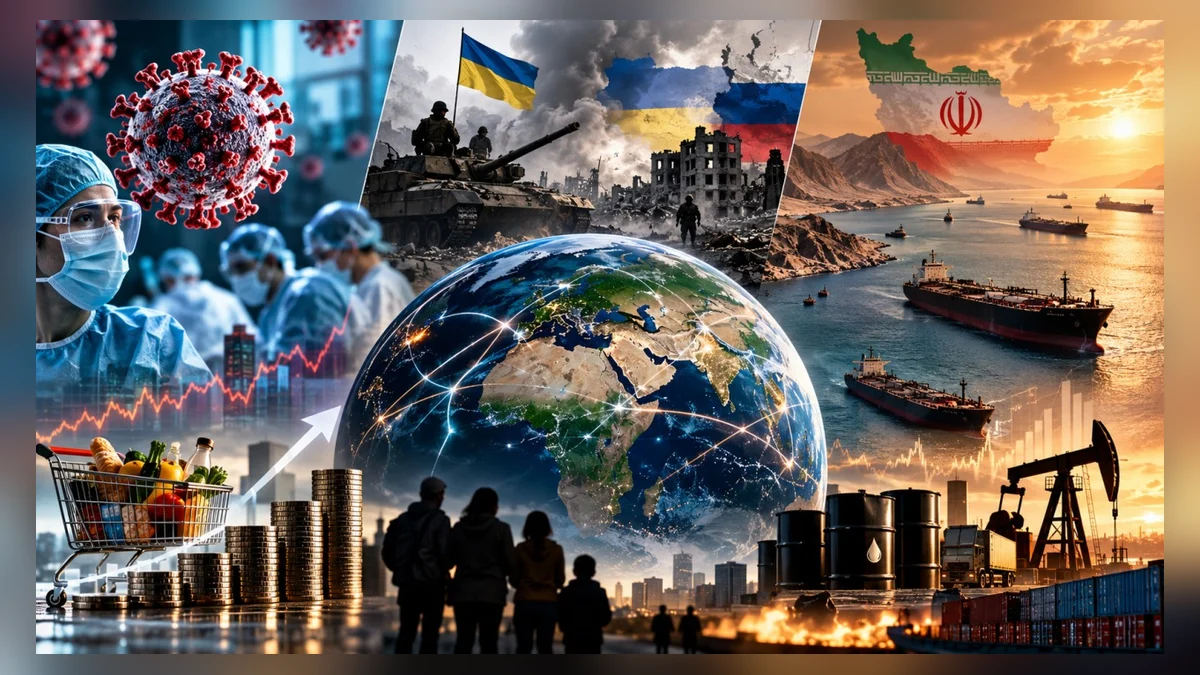
© S. Dahani (AI illustration)
Quick Take
In just a few years, the global economy has endured an extraordinary succession of shocks: the COVID-19 pandemic, the war between Russia and Ukraine, and then escalating conflict in the Middle East accompanied by severe disruptions in the Strait of Hormuz.
These events are fundamentally different. A pandemic is not a war, and an energy crisis does not operate through the same mechanisms as a public-health emergency. Yet their economic consequences eventually converge: exceptional government spending, disrupted supply chains, higher energy costs, inflation, rising debt, weaker growth, and mounting pressure on household purchasing power.
This raises a fundamental question: Is the global economy really moving from one crisis to another, or is it accumulating the consequences of each crisis without having enough time to recover from the previous one?
COVID-19: When Saving Lives Also Meant Saving the Economy
The pandemic was simultaneously a health, human, economic, and fiscal shock.
The World Health Organization estimates that approximately 14.9 million excess deaths were directly or indirectly associated with COVID-19 in 2020 and 2021 alone. This estimate significantly exceeds the number of deaths officially attributed directly to the disease and illustrates the extraordinary scale of the crisis.
Governments responded to the sudden shutdown of large parts of economic activity with equally extraordinary measures. According to the International Monetary Fund, worldwide fiscal measures announced in response to the pandemic had reached approximately $16 trillion by 2021.
These resources supported healthcare systems, households, workers, and businesses facing circumstances without modern precedent.
The intervention was necessary. But it also left a legacy: larger deficits, higher public debt, and reduced fiscal room for maneuver in many countries.
In other words, when the health emergency began to recede, its economic cost did not disappear with it.
Then Came the War in Ukraine
In February 2022, while the world was barely emerging from the most acute phase of the pandemic, Russia’s full-scale invasion of Ukraine triggered another major shock.
This time, the consequences spread particularly through energy, grain, fertilizers, transportation, and international trade.
Europe had to reorganize a significant part of its energy supply. Agricultural markets faced renewed pressure. Public budgets were called upon again to finance defense, international assistance, support for displaced populations, and measures designed to protect households and businesses from rising prices.
And the cost continues to accumulate.
In February 2026, a joint assessment by the Government of Ukraine, the World Bank, the European Commission, and the United Nations estimated Ukraine’s reconstruction and recovery needs at nearly $588 billion over the next decade.
Some of these resources will inevitably come from governments and international institutions that must simultaneously finance other priorities: healthcare, education, infrastructure, the energy transition, climate adaptation, and poverty reduction.
This reveals a less visible dimension of every major crisis:
The cost of a crisis is not limited to the money that is spent. It also includes what could otherwise have been financed with that money.
Hormuz: When a Few Miles Can Affect the Global Economy
The Middle East crisis has introduced another layer of vulnerability.
The Strait of Hormuz is a critical passageway for global energy flows. Serious disruption there can therefore affect far more than oil-producing and oil-consuming countries alone.
In June 2026, the World Bank estimated that disruptions related to the closure of the Strait had significantly affected energy markets. It projected an average Brent crude oil price of $94 per barrel in 2026, 36% above its 2025 level, under the assumption that the most severe disruptions would gradually ease.
Why should this matter to almost everyone?
Because energy is embedded in virtually everything.
More expensive oil → higher transportation costs → higher production costs → more expensive imported goods → pressure on food and industrial prices → weaker household purchasing power.
Fertilizers provide a particularly revealing example. Higher fertilizer costs can pass through to agricultural production and, after a delay, to food prices.
In June, the World Bank projected global growth slowing to 2.5% in 2026, from 2.9% in 2025, while global inflation was expected to rise to 4%.
But Why Don’t Prices Always Come Back Down?
This may be one of the most important economic questions left behind by this succession of crises.
During the pandemic, many price increases were explained by shortages, factory closures, disrupted international transportation, and exceptionally high freight costs.
Some of those pressures later disappeared or diminished considerably.
Yet consumers frequently discover that the normalization of a cost does not automatically mean a return to the previous retail price.
This does not mean that every persistent price increase is artificial or unjustified. Prices depend on many factors: wages, energy, raw materials, exchange rates, rents, taxation, financing costs, competition, and changes in demand.
But it raises a legitimate economic question:
Do prices react as quickly when costs fall as they do when costs rise?
If a transportation company raises its rates when oil prices increase, what happens when oil prices fall?
If a manufacturer increases prices because a critical raw material has become scarce, how much of that increase disappears once supplies normalize?
And when several successive increases become embedded in prices, can they eventually establish a new reference level that the market simply learns to accept?
This question should be distinguished from broad accusations of “excessive profits.” It needs to be investigated sector by sector, using evidence on margins, input costs, market concentration, and competition.
The Invisible Cost: When Money Changes Destination
There is another consequence that receives less attention.
Governments operate with limited resources.
When an emergency occurs, priorities must change.
During COVID-19, trillions of dollars were mobilized to prevent a health, social, and economic collapse. Governments then had to respond to the energy shock, the war in Ukraine, and increased security and defense expenditures.
Today, another major energy disruption once again demands intervention.
But one billion dollars committed to an emergency cannot simultaneously finance another public policy.
Economists describe this as opportunity cost.
The true bill for successive crises therefore cannot be found solely in budget deficits. It may also be hidden in a postponed infrastructure project, a delayed energy transition, deferred investment in education, or additional debt that will have to be serviced for years.
And What About the Environment?
The paradox is particularly important.
Climate change requires enormous and sustained investment. Yet repeated crises force governments to prioritize immediate emergencies.
When an energy crisis threatens supply, securing energy naturally becomes the immediate priority. When war breaks out, security expenditures increase. When a pandemic strikes, healthcare and economic protection move to the front of the queue.
Each decision may be rational when considered individually.
But their accumulation can delay investments whose benefits are measured over decades.
The world therefore faces a paradox:
We are spending enormous amounts repairing the consequences of today’s crises while still needing to finance the prevention of tomorrow’s crises.
Who Ultimately Pays?
The answer is complex.
Governments pay through their budgets.
Businesses pay through higher production and supply costs.
But a significant share of the bill eventually reaches households through higher prices, more expensive credit, present or future taxation, pressure on public services, and slower economic growth.
And the burden is rarely distributed equally.
Higher food or energy prices may be inconvenient for an affluent household. For a family already spending a large share of its income on essential needs, the same increase can become a serious financial constraint.
Low- and middle-income countries often have less fiscal capacity to absorb such shocks as well.
Has the Global Economy Become an Economy of Crises?
COVID-19. Ukraine. The Middle East. Hormuz.
It is tempting to examine each event separately.
But their true economic significance may become clearer when they are placed on the same timeline.
One crisis begins before the bill from the previous one has been fully paid.
Debt accumulates. Investment is redirected. Some prices settle at higher levels. Businesses restructure their supply chains. Governments revise their priorities. Households gradually adjust their consumption.
The fundamental question may therefore no longer simply be:
“How much will this crisis cost?”
It may instead be:
“What is the cost of accumulating successive crises in a global economy that no longer has enough time to regain its balance between shocks?”
And perhaps one final question should be addressed to economists, businesses, and governments:
If the exceptional is becoming permanent, should our economic policies continue to be designed primarily to manage crises — or should we now build economies capable of functioning sustainably through them?
Sources
- World Health Organization — 14.9 million excess deaths were associated with the COVID-19 pandemic in 2020 and 2021, May 5, 2022
- International Monetary Fund — Fiscal Monitor and Database of Fiscal Policy Responses to COVID-19 (about $16 trillion in worldwide fiscal support)
- World Bank, European Commission, United Nations and Government of Ukraine — Ukraine Rapid Damage and Needs Assessment (RDNA5), February 23, 2026
- World Bank — Global Economic Prospects, June 2026