
BUSINESS · HUMAN RESOURCES
From Factory Discipline to AI Management: How Workplace Authority Changed
 By S. Dahani · Founder & Publication Director
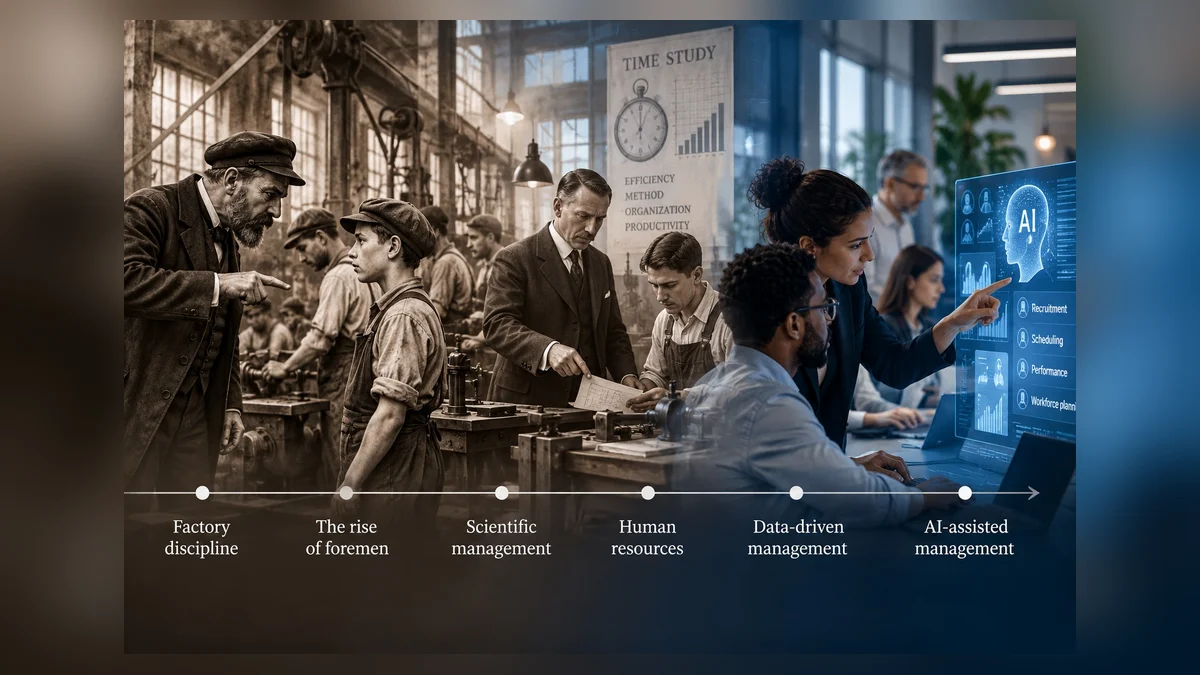
From corporal punishment and the all-powerful foreman to scientific management, human resources and artificial intelligence, the history of workplace authority reveals how profoundly the meaning of “management” has changed.
© S. Dahani (AI illustration)
Quick Take
Modern management did not emerge overnight. During the Industrial Revolution, employers faced a new challenge: organizing large numbers of workers around machines, fixed schedules and production targets.
Discipline could be severe. Historical sources document fines, dismissals and, in certain contexts, corporal punishment—particularly involving apprentices and younger workers.
Over the following two centuries, personal authority gradually gave way to formal rules, specialized supervisors, scientific management, human resources and, today, increasingly data-driven and AI-assisted management.
The tools have changed dramatically. The fundamental question has not:
Who exercises authority in the workplace, according to which rules, and within what limits?
When Authority Was Personal
The Industrial Revolution transformed far more than machinery.
It transformed time itself.
Workers coming from agricultural, artisanal or domestic forms of labor entered factories where production depended on synchronized schedules, machinery and increasingly precise expectations.
Arriving late was no longer simply an individual matter. A worker's behavior could affect an entire production process.
British economic historian Sidney Pollard, in his influential 1963 study Factory Discipline in the Industrial Revolution, showed that one of industrialization's greatest challenges was therefore human as much as technological.
Factory owners had to create a workforce accustomed to regular hours, supervision and industrial discipline.
Employers used different combinations of incentives and sanctions. Depending on the period and workplace, these included rewards, fines, wage deductions, dismissal and, in certain historical circumstances, corporal punishment.
This should not be misunderstood as evidence that every factory owner physically punished workers.
Practices differed substantially between countries, industries and establishments. Corporal punishment appears particularly in historical evidence concerning apprentices and younger workers.
Nevertheless, it reveals something fundamental about the early workplace:
authority was often much more personal than institutional.
Paris, 1878: A Remarkable Historical Document
One document provides particularly revealing evidence.
The International Congress of Commerce and Industry, held in Paris from August 16 to 22, 1878, examined the relationship between employers and apprentices.
Its proceedings addressed corporal correction directly.
The Congress ultimately called upon legislation to exclude corporal punishment of apprentices.
That recommendation is historically significant.
It does not demonstrate that every French employer used physical punishment. Nor does it establish corporal punishment as an official “management technique.”
But it demonstrates something more useful for understanding the evolution of management: physical disciplinary authority over apprentices was sufficiently important to require explicit discussion at an international gathering devoted to commerce and industry.
The proceedings also considered replacing physical correction with non-corporal disciplinary measures.
That represents an important conceptual shift.
Authority was beginning to move from:
“The person in charge decides how to punish”
toward:
“The organization establishes rules governing discipline.”
That distinction lies close to the foundations of modern management.
The Rise of the Foreman
As factories expanded, another problem emerged.
An owner could personally supervise a workshop containing a relatively small number of workers.
But what happens when dozens become hundreds—and eventually thousands?
A new layer of authority becomes necessary.
The foreman emerged as one of the defining figures of industrial organization.
Foremen assigned tasks, monitored production, enforced schedules and represented the employer on the factory floor.
Management was beginning to acquire a hierarchy.
Yet the foreman's authority could still be highly personal.
A striking French discussion from 1893, published in Le Devoir, criticized the traditional relationship between employer, foreman and worker. Its authors imagined a different industrial organization in which the employer would no longer act as a “possessor of men”, while the foreman would cease to function as the employer's harsh enforcer.
The terminology reflected the social and political debates of its period and should not be treated as a neutral description of every factory.
Its importance lies elsewhere.
By the end of the nineteenth century, industrial thinkers were increasingly asking not only:
Who owns the company?
but also:
How should authority inside the company be organized?
That is fundamentally a management question.
Taylor Turns Authority Into a System
At the beginning of the twentieth century, Frederick Winslow Taylor introduced one of the most influential—and controversial—answers.
Taylor believed that industrial work relied too heavily on informal practices and individual judgment.
Work could instead be studied.
Tasks could be divided.
Time could be measured.
Methods could be standardized.
Planning could increasingly be separated from execution.
The result became known as scientific management.
Taylor did not eliminate hierarchy. Quite the opposite: his system could impose intense managerial control over the worker, which is one reason Taylorism generated substantial criticism.
But Taylor changed the nature of authority.
Instead of allowing one foreman to exercise a broad range of responsibilities largely through personal experience, Taylor proposed functional foremanship.
Different supervisors could specialize in different aspects of production and management.
Authority was becoming a system.
And this represents one of the most important transitions in the history of the workplace:
Management was becoming a profession rather than merely an expression of ownership or personal power.
France Studies the New Science of Work
The transformation quickly became an international intellectual subject.
In 1916, French psychologist Jean-Maurice Lahy published Le système Taylor et la physiologie du travail professionnel.
The very existence of such research illustrates how dramatically perceptions of the workplace had changed.
Industrial organization could now be studied scientifically.
The company was increasingly understood as a structure containing different levels of responsibility:
management → workshop supervisors → foremen → team leaders → workers.
The challenge was no longer simply to make people obey.
It was to organize an entire productive system.
From Commanding Workers to Managing People
The twentieth century brought another major transformation.
Industrial psychology developed.
Labor law expanded.
Trade unions and collective bargaining altered workplace power relationships.
Personnel departments appeared and eventually evolved into modern human resources.
Management theory increasingly explored motivation, leadership, organizational culture, communication and employee engagement.
The manager was no longer supposed merely to command.
The modern manager was increasingly expected to:
organize, communicate, establish objectives, evaluate performance, resolve conflicts, motivate teams and remain accountable for decisions.
The historical movement was profound:
from personal command to organizational authority;
from physical correction to formal procedure;
from the all-powerful supervisor to defined managerial responsibility.
None of this happened in a straight line.
Authoritarian management did not disappear when Taylor published his ideas. Scientific management did not disappear when human-relations theories became influential. And modern human resources did not eliminate workplace conflict.
Each generation added new layers to the organization.
Then Came Data
By the late twentieth and early twenty-first centuries, management acquired another powerful tool: data.
Companies could measure productivity at a scale previous generations could barely imagine.
Digital systems could track sales, production, logistics, attendance, customer satisfaction and employee performance.
Dashboards increasingly joined managers in the decision-making process.
Then artificial intelligence arrived.
And the historical question changed again.
When the Manager Becomes an Algorithm
Artificial intelligence is beginning to influence recruitment, scheduling, productivity analysis, customer service, workforce planning and decision support.
An AI system does not need to become someone's “boss” for this transformation to matter.
If software recommends which candidate should be interviewed, predicts staffing requirements, measures productivity or identifies employees who may need additional support, technology is already participating in decisions that once belonged almost entirely to human managers.
That creates an extraordinary historical contrast.
In the nineteenth century, reformers increasingly attempted to replace personal arbitrariness with rules.
In the twentieth century, companies transformed those rules into sophisticated management systems.
In the twenty-first century, some of those systems are becoming algorithmic.
200 Years of Workplace Authority
The evolution can be summarized in a remarkably simple timeline:
| Period | Milestone |
|---|---|
| Early Industrial Revolution | Personal employer authority and factory discipline |
| 19th Century | Foremen, factory rules and emerging limits on physical discipline |
| 1878 | International Congress in Paris calls for the exclusion of corporal punishment of apprentices |
| 1911 | Taylor publishes The Principles of Scientific Management |
| 20th Century | Industrial psychology, labor law, personnel management and human resources |
| Late 20th–Early 21st Century | Digital management and performance analytics |
| Today | AI-assisted management and algorithmic decision-making |
The Technology Changed. The Question Didn't.
The history of management is often presented as a succession of theories: Taylorism, human relations, organizational behavior, human resources, digital transformation and now artificial intelligence.
But underneath those theories lies a much older question.
Who has the right to direct another person's work?
And immediately behind it come three more:
How should that authority be exercised?
Who establishes its limits?
Who is accountable when it is abused?
The Industrial Revolution answered those questions very differently from a modern corporation.
Artificial intelligence may force us to answer them again.
Two centuries ago, workplace authority could be embodied almost entirely in an individual employer or foreman.
Today it may be distributed among managers, HR departments, corporate policies, labor regulations, software and algorithms.
Technology has transformed the tools.
Society has transformed the rules.
But the central challenge of management remains remarkably familiar:
how to organize human work without allowing authority to become arbitrary power.
Sources
- Sidney Pollard — Factory Discipline in the Industrial Revolution, The Economic History Review, New Series, Vol. 16, No. 2, 1963, pp. 254–271
- International Congress of Commerce and Industry — Paris, August 16–22, 1878 - proceedings on employer-apprentice relationships, disciplinary measures and corporal punishment (CNUM-CNAM digitized collection)
- Le Devoir — Vol. 17, 1893 - discussions on industrial organization, employer-worker relationships and the role of foremen (CNUM-CNAM collection)
- Frederick Winslow Taylor — The Principles of Scientific Management, 1911
- Jean-Maurice Lahy — Le système Taylor et la physiologie du travail professionnel, Paris, 1916 (Conservatoire national des arts et métiers historical collection)