
BUSINESS · ECONOMY
Americans’ Purchasing Power at the Heart of Economic and Social Concerns in 2026
 By S. Dahani · Founder & Publication Director
Gasoline, groceries, housing and healthcare: surveys, confidence indexes and financial-health data show why the cost of living dominates American concerns in 2026, and what forecasters expect for 2027–2029.
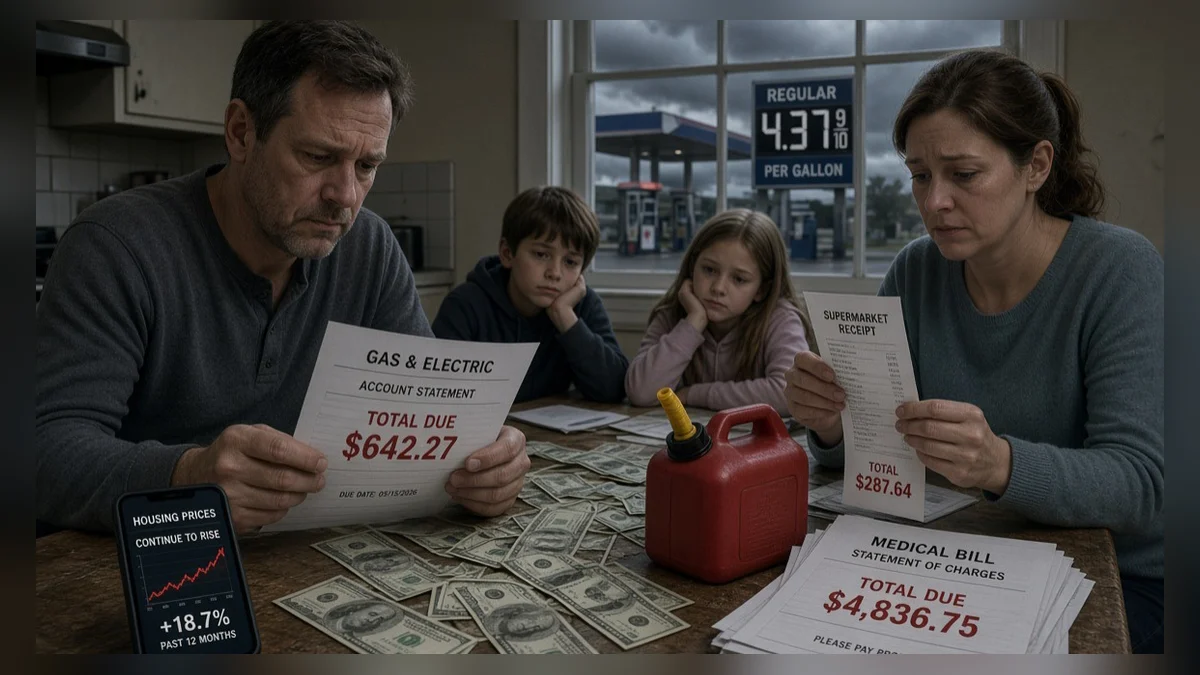
© S. Dahani (AI illustration)
Quick Take
In October 2026, purchasing power has emerged as Americans’ central concern. The latest data from the Pew Research Center, collected between September 28 and October 4, 2026, from more than 5,000 adults, confirm this with unusual clarity. Eighty-four percent of registered voters consider the economy a “very important” issue in the midterm elections. Behind this overall figure lie very concrete concerns: 74% are very concerned about gasoline and energy prices, 73% about the cost of food and consumer goods, 69% about healthcare costs, and 66% about housing costs. Nearly half (48%) are also concerned about the difficulty of finding a job. These four spending categories lie at the heart of the purchasing power problem currently dominating American public debate.
Historically low consumer confidence
The backdrop is historically low consumer confidence. The University of Michigan’s index reached 46.3 in October 2026, one of the lowest levels ever recorded. The Conference Board, meanwhile, reported a confidence index of 81.9 in September, its lowest level since 2014. Only 21% of Americans describe economic conditions as “excellent or good,” while 65% believe the Trump administration’s economic policies have made conditions worse. These assessments partly transcend partisan divisions, although Democrats remain more pessimistic.
Energy and food are the most visible expenses
Energy prices are the most visible factor. The national average price of a gallon of regular gasoline stands at around $4.37. This increase, amplified by the conflict with Iran, has pushed the share of Americans who are “very concerned” about energy prices from 43% in January 2026 to 74% in October. For households that depend on a car, every fill-up involves a trade-off. Trips are combined, and some journeys are postponed, including those needed to get to work or see a doctor.
Food costs are following a similar trajectory. Seventy-three percent of Americans are very concerned about the cost of food and consumer goods. Grocery bills have risen, promotions have become less frequent, and many families have changed their shopping habits. Food banks report increased demand, including from households that, until recently, considered themselves firmly middle class.
Housing and healthcare are structural constraints
This pressure on food budgets is compounded by housing costs, which concern 66% of the population. Rent and mortgage payments absorb a growing share of disposable income. High interest rates and the limited supply of available housing hinder homeownership, particularly for first-time buyers.
Healthcare costs impose a similar budgetary constraint. Sixty-nine percent of Americans count them among their most serious concerns. Insurance premiums, deductibles, and out-of-pocket expenses weigh heavily on household finances. For many households, an unexpected medical expense can upset an already fragile monthly budget. This is not an isolated issue: it is another expense added to the other three—energy, food, and housing—further reducing financial flexibility.
Growing financial vulnerability
Indicators of financial vulnerability confirm this strain. According to the Financial Health Network’s 2026 report, the share of households considered “financially vulnerable” rose from 15% to 17% in one year, equivalent to approximately 1.8 million additional households. Reported financial stress stands at 16%. The proportion of households reporting unmanageable debt has reached 31%, an eight-year high. Student loan borrowers and low-income households are the most exposed. Against this backdrop, the labor market, described by several analysts as a “low hire, low fire” environment, provides insufficient relief. Forty-eight percent of Americans are very concerned about the difficulty of finding employment for those seeking a job.
A divided economy and its social consequences
This situation is producing an increasingly divided economy, often described as “K-shaped.” The highest-income 20%, who hold a disproportionate share of financial assets, continue to account for a substantial share of consumption. The rest of the population is cutting back. Real wages have stagnated or declined for large segments of the workforce. Artificial intelligence, presented as an engine of growth, is viewed with skepticism by 50% of Americans, who fear it will deepen inequalities in income and employment.
The social consequences stem directly from these economic constraints. Late payments are becoming more common, reliance on food assistance is increasing, and money-related stress is affecting mental health and family relationships. Mayors from more than 100 American cities, surveyed in September 2026, report that 96% of their residents are very or extremely concerned about the cost of living. Housing tops the list of cited causes, closely followed by other essential expenses.
A central political issue
Politically, purchasing power has become the lens through which almost every other issue is viewed. The economy dominates voting intentions for the November 2026 midterms, ahead of democracy, healthcare, immigration, and climate change. Partisan differences exist over the ranking of secondary priorities, but there is broad agreement on the importance of the cost of living.
Outlook for the next three years (2027–2029)
Available forecasts point to gradual normalization, without a rapid return to comfortable purchasing power. According to the Congressional Budget Office (CBO, February 2026), real GDP growth is expected to reach around 2.2% in 2026 before slowing to approximately 1.8% annually in 2027 and 2028. Inflation, measured by the personal consumption expenditures (PCE) price index, is projected at 2.7% in 2026, followed by 2.3% in 2027 and 2.1% in 2028, approaching the Federal Reserve’s 2% target around 2030. The Federal Reserve Bank of Philadelphia’s Survey of Professional Forecasters (third quarter of 2026) anticipates growth of between 2.1% and 2.4% over 2026–2029, with CPI inflation gradually declining toward 2.3%.
S&P Global Ratings (third-quarter 2026 outlook) forecasts growth of 2.1% in 2026, followed by 1.9% in 2027 and 2028, before a return to 2.1% in 2029. CPI inflation is expected to average 4.0% in 2026 before slowing to 2.5% in 2027. The Peterson Institute for International Economics (October 2026) projects U.S. growth of 2.3% in 2026 and 2.2% in 2027, with PCE inflation declining to 2.3% in 2027. Several institutions emphasize that artificial intelligence will support investment, but its effects on employment and real wages among middle- and lower-income groups will remain limited in the short term.
| Institution | Real GDP growth | Inflation |
|---|---|---|
| Congressional Budget Office (Feb. 2026) | ≈2.2% in 2026, then ≈1.8% a year in 2027–2028 | PCE: 2.7% (2026), 2.3% (2027), 2.1% (2028) |
| Philadelphia Fed, Survey of Professional Forecasters (Q3 2026) | 2.1%–2.4% over 2026–2029 | CPI easing gradually toward 2.3% |
| S&P Global Ratings (Q3 2026) | 2.1% (2026), 1.9% (2027–2028), 2.1% (2029) | CPI: 4.0% average in 2026, 2.5% in 2027 |
| Peterson Institute (Oct. 2026) | 2.3% (2026), 2.2% (2027) | PCE: 2.3% in 2027 |
Within this framework, purchasing power should recover slowly. The expected decline in energy and food inflation, if it materializes, would ease pressure on household budgets. However, housing and healthcare costs are likely to remain persistent sources of strain, as they respond more slowly to changes in monetary policy. The CBO and several private forecasters also note that high public debt and elevated interest rates will continue to put pressure on public finances, limiting the fiscal room for possible measures to support purchasing power.
Significant risks remain. A renewed rise in energy prices driven by geopolitical tensions, a correction in financial markets, or a sharper slowdown in household consumption could delay improvement. Conversely, a lasting resolution of tensions in the Middle East and a faster normalization of inflation would offer more substantial relief. In all central scenarios, however, purchasing power is not expected to return to a level of comfort comparable to that before the period of high inflation until a more distant horizon, beyond 2029.
Conclusion
In summary, 2026 marks a peak in American concern about the cost of living. Survey data, confidence indicators, and reports on households’ financial health converge: gasoline, food, housing, and healthcare form a set of constraints that weigh heavily on the daily lives of most households. The outlook for 2027–2029 suggests a gradual easing of these pressures, but no rapid resolution. Purchasing power will remain a major economic and social issue in the United States over the coming years.
Sources
- Pew Research Center — Cost Concerns Dominate as Public’s Economic Ratings Turn More Negative, October 8, 2026
- Pew Research Center — Economy Is Top Issue in Midterms for All Voters, October 8, 2026
- University of Michigan — Surveys of Consumers, October 2026 (sentiment index at 46.3)
- The Conference Board — Consumer Confidence Index, September 2026 (81.9)
- Financial Health Network — Financial Health Pulse 2026 U.S. Trends Report
- AAA — national gasoline price data, October 2026
- U.S. Conference of Mayors — national affordability survey, September 2026
- Congressional Budget Office — The Budget and Economic Outlook: 2026 to 2036, February 2026
- Federal Reserve Bank of Philadelphia — Survey of Professional Forecasters, third quarter 2026
- S&P Global Ratings — Economic Outlook U.S. Q3 2026
- Peterson Institute for International Economics — projections, October 2026
- Newsweek, CNN Business, Reuters and PBS News — coverage and analysis of the surveys and indicators, September–October 2026