BUSINESS · HUMAN RESOURCES
After the Rise of Artificial Intelligence, How Are Major U.S. Companies Redefining Their Hiring Standards?
 By S. Dahani · Founder & Publication Director
Degrees and résumés still count, but major U.S. employers now look harder at demonstrated skills, AI literacy, judgement and the ability to learn fast.
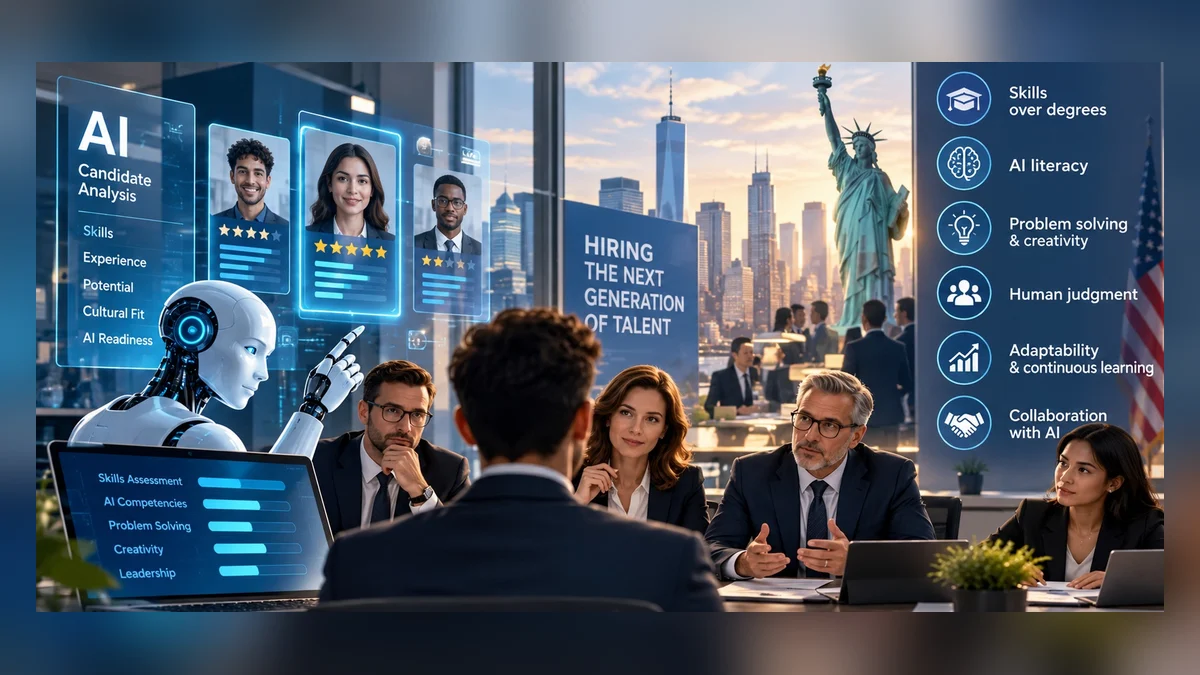
© S. Dahani (AI illustration)
Quick Take
For decades, recruitment at major American corporations relied heavily on familiar signals: university degrees, the reputation of the institution attended, years of experience, previous job titles and the quality of a candidate's résumé.
Artificial intelligence is beginning to change that hierarchy.
As generative AI and intelligent agents take over tasks once performed exclusively by employees, companies are increasingly looking beyond a person's ability to execute a predefined set of tasks. They are placing greater value on the ability to work with technology, solve problems, learn quickly and exercise sound judgement when machines reach their limits.
AI proficiency, therefore, is not simply another technical skill to add to a résumé. A deeper transformation of hiring is underway.
From credentials to demonstrated skills
One of the most significant developments is the rise of skills-based hiring.
The principle is straightforward. Instead of beginning with the question, “What degree does this candidate have?”, employers increasingly want to know, “What can this person actually do?”
LinkedIn's Future of Recruiting 2025 reports that 93% of talent acquisition professionals surveyed consider accurately assessing candidates' skills crucial to improving quality of hire. LinkedIn's platform data also indicates that companies making the greatest use of skills-based searches are 12% more likely to achieve what LinkedIn defines as a quality hire.
The change is beginning to affect academic requirements as well. LinkedIn reports that 26% of sponsored job postings on its platform did not require a university degree in 2023, compared with 22% in 2020.
This does not mean degrees are disappearing. Formal qualifications remain essential in medicine, regulated engineering, law and many specialized professions. But in a growing number of occupations, a degree is becoming one indicator among several rather than the sole gateway to employment.
Experience still matters — but it may no longer be enough
It would be premature to announce the death of professional experience.
The World Economic Forum's Future of Jobs Report 2025 found that 81% of surveyed businesses expect to continue using work experience as an assessment mechanism between 2025 and 2030.
What is changing is that 48% also expect to use direct skills assessments.
Tomorrow's candidate may therefore be evaluated simultaneously on what they have done, what they can do today and how quickly they can learn what they will need to do tomorrow.
That final dimension becomes particularly important in the age of AI.
AI literacy is becoming a workplace skill
Only a few years ago, understanding artificial intelligence could be considered an advantage largely confined to technology roles. That distinction is rapidly becoming less clear.
Marketing, finance, human resources, consulting, software development, data analysis, customer service and project management are all increasingly affected.
Microsoft and LinkedIn research previously found that 66% of surveyed leaders said they would not hire someone without AI skills, while 71% said they would prefer a less experienced candidate with AI skills over a more experienced candidate without them.
The trend has since deepened.
Microsoft's 2025 Work Trend Index reported that 78% of leaders were considering hiring for new AI-related roles. At the same time, businesses are beginning to envision organizational structures in which people work directly alongside AI agents.
The desirable employee, therefore, is not necessarily the person who competes with the machine. Increasingly, it is the person who knows how to delegate appropriate tasks to AI, evaluate its output, identify mistakes and use the time saved to create greater value.
The paradox: As AI advances, human abilities become more valuable
One might expect a highly automated economy to value technical skills almost exclusively.
Available evidence suggests a more complex reality.
The World Economic Forum identifies AI, big data, networks and cybersecurity among the fastest-growing areas of skills demand. Yet it simultaneously emphasizes analytical thinking, creativity, resilience, flexibility, leadership and collaboration.
PwC reaches a similar conclusion in its 2026 Global AI Jobs Barometer, based on an analysis of more than one billion job advertisements. Skills required in the most AI-exposed occupations are changing more than twice as quickly as those in less exposed jobs, while human capabilities such as judgement, creativity and leadership are becoming increasingly important.
This represents one of the great paradoxes of the current technological revolution:
The more machines become capable of performing routine work, the more human value shifts toward what machines cannot easily replicate.
Entry-level jobs are becoming more demanding
This transformation also affects younger candidates.
Traditionally, an entry-level employee performed relatively simple tasks and gradually progressed toward responsibilities requiring greater judgement.
AI can now perform some of those traditional entry-level tasks.
PwC's 2026 analysis found that highly AI-exposed junior roles are seven times more likely than the least AI-exposed junior roles to demand abilities traditionally associated with more senior employees, including leadership and strategic thinking.
This could gradually alter one of the traditional rules of employment: gain seniority first, responsibility later.
The ability to demonstrate judgement and autonomy early in a career may become increasingly valuable.
IBM: Testing what candidates can actually do
IBM provides a useful real-world example of this changing approach.
Its official recruitment information explains that, depending on the position, candidates may undergo technical assessments, coding exercises, video assessments or language evaluations.
IBM also states that it looks for candidates with skills, knowledge and experience in artificial intelligence while recognizing the growing use of AI by candidates themselves during recruitment.
This distinction is revealing.
The question is no longer simply whether a candidate uses AI. Employers increasingly need to determine how that person uses AI and how much genuine human competence lies behind the result.
Practical demonstrations, case studies, portfolios, simulations and deeper interviews may consequently become more important.
The AI-generated résumé is losing some of its power to differentiate candidates
There is another, less frequently discussed consequence.
When almost any applicant can use generative AI to create a polished résumé or professionally written cover letter within seconds, the formal quality of these documents becomes less informative about the actual quality of the candidate.
The résumé is not disappearing. But it increasingly serves as an entry point rather than sufficient proof of ability.
To distinguish between candidates with similarly impressive applications, employers may seek stronger evidence: completed projects, portfolios, tests, problem-solving exercises, explanations of past decisions, references or the ability to defend a recommendation during an interview.
Ironically, therefore, AI's ability to make applications look better may increase employers' need to verify the skills behind those applications.
A new hiring standard is emerging
Taken together, recent research and corporate practices point toward several criteria that are becoming increasingly important across major American and international companies.
- Demonstrated ability. Candidates increasingly need to show what they can accomplish rather than simply claim expertise.
- AI literacy. Employees do not all need to become AI engineers, but understanding what AI can and cannot do is becoming relevant across a growing range of occupations.
- Judgement. Professionals must know when to accept, verify, correct or reject an AI-generated recommendation.
- Adaptability. When tools can change within months, the ability to learn becomes a permanent professional capability.
- Human-machine complementarity. Companies increasingly need employees who can use automation to amplify their productivity rather than merely reproduce tasks that machines can already perform.
- Human skills. Communication, leadership, creativity, collaboration and critical thinking become more valuable precisely because parts of technical and administrative work can be automated.
A different question for a different era
Perhaps the deepest transformation lies in the question employers ask candidates.
Yesterday, the question might have been:
“Where did you study, and how many years of experience do you have?”
Increasingly, the question is:
“What can you do?”
Tomorrow, it may become:
“What can you accomplish when your human expertise is augmented by artificial intelligence?”
AI does not necessarily signal the end of human recruitment. Instead, it is forcing organizations to reconsider what they mean by talent.
Degrees, experience and résumés will not disappear. But they increasingly coexist with new indicators: demonstrable skills, AI literacy, learning ability, judgement, creativity and the capacity to collaborate effectively with intelligent systems.
In this new economy, possessing information may matter less than it once did.
Knowing what to do with it may become the skill that matters most.
Sources
- LinkedIn — The Future of Recruiting 2025 (skills-based hiring, quality-of-hire data and changing degree requirements)
- World Economic Forum — Future of Jobs Report 2025 (survey of more than 1,000 employers)
- Microsoft — 2025 Annual Work Trend Index - The Frontier Firm Is Born
- Microsoft & LinkedIn — Work Trend Index - AI at Work Is Here. Now Comes the Hard Part
- PwC — 2025 Global AI Jobs Barometer (nearly one billion job advertisements)
- PwC — 2026 Global AI Jobs Barometer (more than one billion job advertisements, human skills and entry-level employment)
- IBM Careers — Application Process and FAQ (candidate assessments and acceptable use of AI during recruitment)