
BUSINESS · HUMAN RESOURCES
When America Hired at a Glance: The Surprising Recruitment Methods of the Industrial Age
 By S. Dahani · Founder & Publication Director
In 1900, a foreman at the factory gate often decided who got hired. How industrial America recruited, and how that gave birth to human resources.
© S. Dahani (AI illustration)
Quick Take
Today, getting a job can feel like running an obstacle course: an optimized résumé, a LinkedIn profile, an online application, a video interview, personality tests, reference checks, and sometimes several rounds of interviews before receiving an answer.
In late 19th-century America, the process could be considerably more straightforward.
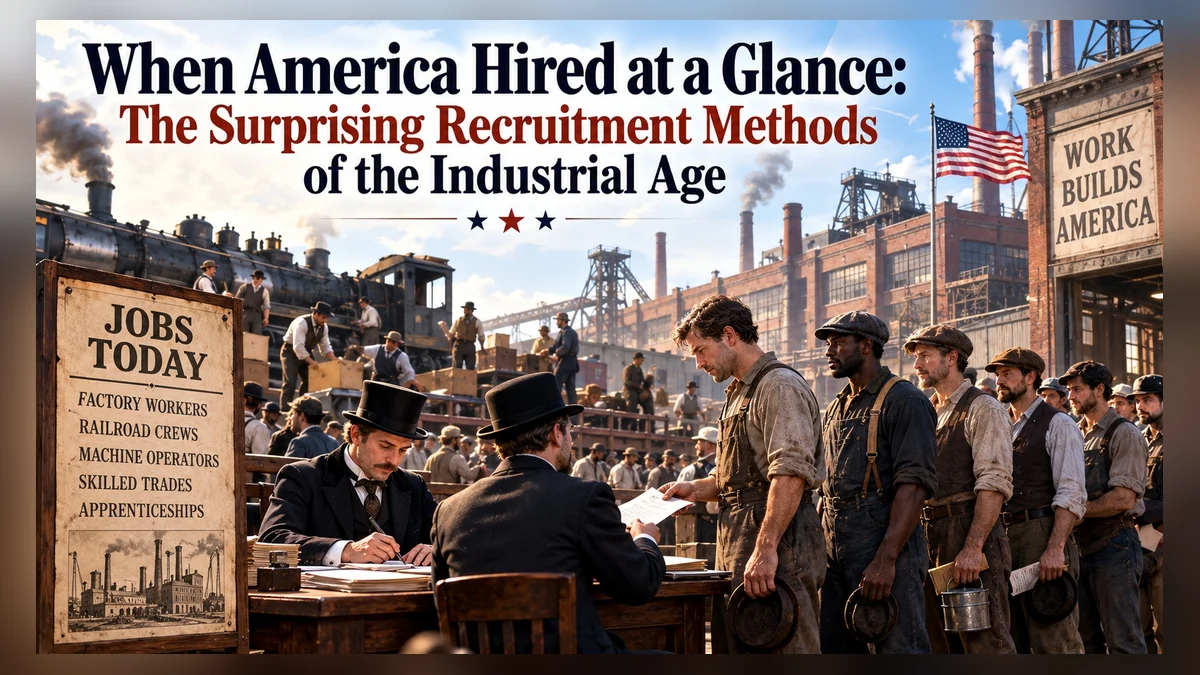
Picture the scene: you arrive outside a factory at dawn. Dozens of men are already waiting. A foreman needs a few extra workers. No three-page résumé. No cover letter explaining why your childhood dream was to spend twelve hours a day beside a roaring industrial machine.
What mattered most was being there, looking capable of doing the job, and convincing the right person.
Welcome to industrial America.
An Economy Transformed at Extraordinary Speed
After the Civil War, the United States experienced extremely rapid industrialization. Railroads expanded across the country, while steel, oil, manufacturing, and eventually electricity transformed the American economy.
Between 1860 and 1900, approximately 14 million immigrants arrived in the United States, creating a vast pool of labor for the country's expanding industries. During the final decades of the 19th century, the United States progressively emerged as one of the world's major industrial powers. [1]
Factories faced a very practical problem: they needed workers.
A lot of workers.
Recruitment, however, was not yet a structured profession in the modern sense. Modern human resources departments essentially did not exist. Around 1900, hiring decisions were still largely entrusted to operational managers and foremen. [2]
In other words, your professional future could depend more on the impression you made on a factory supervisor than on a systematic assessment of your qualifications.
The Résumé? What Résumé?
For many low-skilled industrial jobs, companies were primarily looking for people capable of performing the required tasks and adapting to factory discipline.
Mechanization had profoundly changed the nature of work. In earlier periods, a skilled craftsman might produce an object almost entirely by himself. In the mechanized factory, production was increasingly divided into smaller, repetitive operations. A worker could therefore spend the entire day performing essentially the same movement or task.
The Library of Congress notes that mechanization accelerated the pace of work and strengthened an industrial discipline based on fixed and often very long working hours. [3]
This helps explain why recruitment could be relatively rudimentary: for certain positions, employers were not necessarily searching for candidates with the most impressive academic background. They needed someone who could immediately occupy a specific place in the production process.
Translated into today's language, the conversation might almost have sounded like this:
— Do you have experience?
— A little.
— Can you start today?
— Yes.
— Congratulations.
Of course, this dialogue is a caricature. But it illustrates an important reality: industrial recruitment was far less institutionalized than modern hiring practices.
The Foreman: HR Manager, Recruiter, and Boss in One
Before dedicated personnel departments appeared, direct supervisors often held considerable power over hiring.
According to the Society for Human Resource Management (SHRM), at the beginning of the 20th century, the concept of a dedicated personnel department was still far from universal, and employment decisions were largely handled by first-line supervisors. The first specialized employment clerks, whose responsibilities included selecting workers, gradually appeared in the early 20th century. [2]
The professional recruiter we know today is therefore the result of a long evolution.
The foreman of 1900 had no applicant-tracking software and no artificial intelligence system analyzing résumés.
He had his eyes, his experience, and the immediate needs of his workshop.
Immigration: A Vast New Workforce
American industrialization coincided with major waves of immigration.
New arrivals found employment in mines, steel mills, textile factories, construction, and many other industrial activities. At the same time, Americans from rural areas migrated toward rapidly growing industrial cities.
America's economic expansion therefore created an enormous working class made up of both immigrants and migrants from rural communities. [4]
This abundance of labor helps explain some recruitment practices: for jobs requiring relatively little prior training, employers could sometimes replace one worker with another fairly quickly.
But industrialization carried a considerable social cost.
Wages could be low, employment unstable, and working conditions difficult. Conflicts between employers and workers increased, as did labor movements, union organization, and strikes. [3][4]
Rapid recruitment was therefore part of a much broader industrial system in which productivity occupied a central position.
Then Came Frederick Winslow Taylor
Around the turn of the 20th century, a new idea began transforming business management:
What if work could be organized scientifically?
One of the figures most closely associated with this managerial revolution was the American engineer Frederick Winslow Taylor.
Taylor worked at companies including Midvale Steel and Bethlehem Steel and gradually developed what became known as scientific management. He sought to analyze tasks, measure their execution, and determine more efficient methods of performing them. [5]
His book The Principles of Scientific Management, published in 1911, became one of the most influential texts in the history of management.
The logic gradually changed.
Instead of simply asking:
“Who wants to work?”
Companies increasingly began asking:
“Which worker is best suited to this task, and how should that task be performed?”
The difference may seem small.
Yet it signaled a profound transformation in personnel management.
From “Find Me Ten Workers” to the Birth of Human Resources
The evolution accelerated during the early 20th century.
Companies became enormous. Their workforces expanded. Administrative tasks multiplied. Modern offices developed alongside factories, creating demand for new skills such as accounting, stenography, typing, management, and administration. [6]
It became increasingly unrealistic to expect a foreman to manage recruitment alone.
Companies therefore gradually began establishing specialized functions responsible for employment and personnel management.
The change became particularly noticeable during and after World War I. According to SHRM, only 5% of large American companies had personnel departments in 1915, compared with approximately 20% by 1920. [2]
In just five years, the personnel function had begun to become institutionalized.
Recruitment was gradually ceasing to be merely an improvised decision made on the factory floor and becoming an identifiable administrative function.
A Quiet Revolution Behind the Industrial Revolution
The history of American industrialization is therefore not only the story of locomotives, steel mills, oil, and production lines.
It is also the story of a transformation in the relationship between companies and workers.
At first, many businesses mainly needed to find enough people to keep their machines running.
Then companies began measuring work.
Defining jobs.
Selecting workers more systematically.
Creating specialized employment offices.
And eventually developing what we now call human resource management.
In little more than a century, we have moved from a foreman looking over candidates outside his factory to digital platforms capable of filtering thousands of applications in seconds.
The job seeker of 1900 would probably be astonished by our modern recruitment procedures.
But he might also ask a very reasonable question:
“All of this just to decide whether you're going to hire me?”
And on that point, despite more than a century of technological progress, he might not be entirely wrong.
Sources
- Library of Congress — The Industrial Revolution in the United States (about 14 million immigrants between 1860 and 1900)
- Society for Human Resource Management (SHRM) — How We Got Here - The 75-Year Evolution of SHRM and HR, 2023
- Library of Congress — Work in the Late 19th Century (mechanization, division of labor, factory discipline, labor movements)
- Library of Congress — Rise of Industrial America, 1876–1900 - Overview
- Frederick Winslow Taylor / Library of Congress — Scientific Management and historical materials relating to Taylor
- Library of Congress — Office Management & Administration - History of the Office and Office Equipment
- Frederick Winslow Taylor — Shop Management, 1903 (digitized collections of the Library of Congress)